
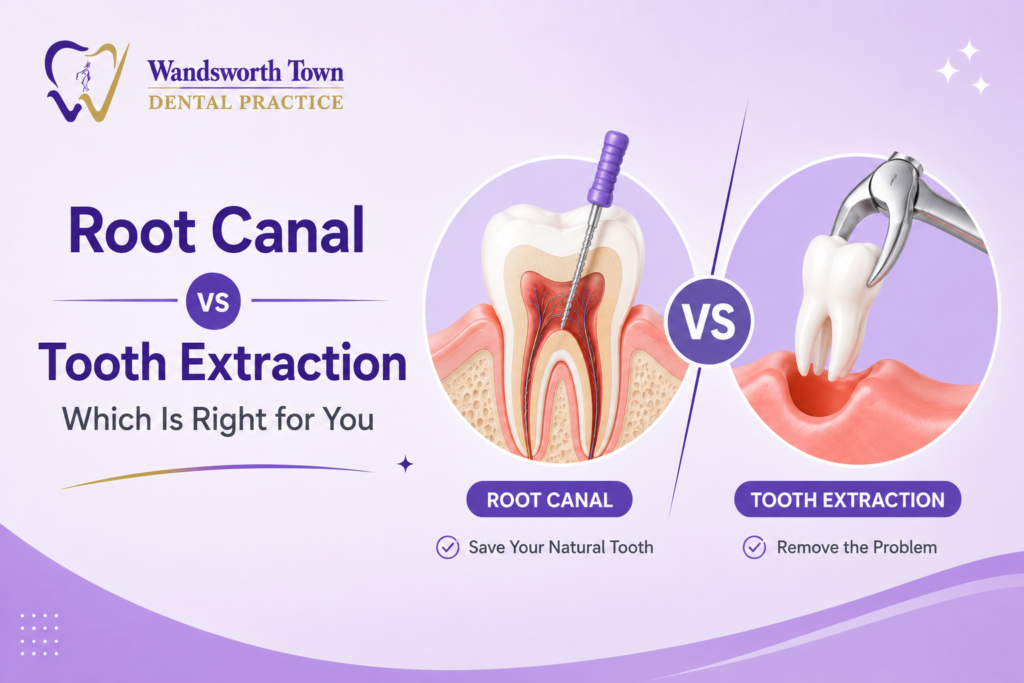
Root Canal vs Tooth Extraction: Which Is Right for You?
When a tooth is badly damage, infect, or causing ongoing pain, your dentist may recommend either a root canal treatment or tooth extraction. Both treatments can relieve pain and address dental problems, but they work in very different ways.
So, root canal vs tooth extraction—which is right for you? The answer depends on the condition of your tooth, the extent of damage, your oral health, and your dentist’s professional assessment.
At Wandsworth Town Dental Practice, we help patients understand their treatment options so they can make informed decisions about their dental health.
What Is a Root Canal Treatment?
A root canal treatment is a dental procedure use to save a tooth when the soft tissue inside it, called the pulp, becomes infect or inflame.
During the treatment, the dentist removes the infected pulp, carefully cleans the inside of the tooth, and seals it to help prevent further infection. A dental crown may also be recommend to protect a weaken tooth.
A root canal can be an option when the tooth has enough healthy structure remaining to be restore.
Common Reasons for Root Canal Treatment
You may need a root canal if you have:
- A deep tooth infection
- Severe tooth decay
- A cracked or damaged tooth
- Long-lasting tooth sensitivity
- Pain when biting or chewing
- Swelling around the tooth
- An abscess or dental infection
What Is Tooth Extraction?
Tooth extraction involves removing a tooth from its socket. It may be recommend when a tooth is too damage or unhealthy to be successfully restore.
Although dentists generally aim to preserve natural teeth whenever possible, extraction can sometimes be the safest option for your overall oral health.
Common Reasons for Tooth Extraction
A dentist may recommend extraction when:
- The tooth is severely damage or decay
- There is not enough healthy tooth structure to restore it
- A serious infection cannot be treat successfully
- The tooth is badly crack below the gum line
- Severe gum disease has made the tooth loose
- There is not enough space for the tooth
- A wisdom tooth is causing repeated problems
Root Canal vs Tooth Extraction: Key Differences
The main difference is simple: a root canal aims to save your natural tooth, while extraction removes the tooth.
Root Canal Treatment | Tooth Extraction |
Saves the natural tooth | Removes the natural tooth |
Removes infected pulp | Removes the entire tooth |
Usually requires one or more appointments | May be complete in one appointment |
The tooth can continue to function | The missing tooth may need replacement |
A crown may be need afterwards | Implant, bridge, or denture may be considered |
Is a Root Canal Better Than an Extraction?
In many cases, keeping your natural tooth is preferable when it can be successfully restored. A root canal can remove infection while allowing you to keep the tooth and continue using it normally.
However, a root canal is not suitable for every tooth. If the tooth has extensive damage and cannot be restored reliably, extraction may provide a better long-term solution.
Your dentist will assess the tooth and surrounding tissues before recommending the most appropriate treatment.
Is Tooth Extraction Ever the Better Choice?
Yes. Sometimes extraction is the most practical and predictable option.
For example, if a tooth has very little healthy structure remaining, is severely crack, or has advance damage that cannot be repair, trying to save it may not provide a good long-term outcome.
After extraction, your dentist can discuss ways to replace the missing tooth if necessary. Options may include a dental implant, bridge, or denture, depending on your individual needs.
Which Treatment Is More Painful?
Modern dental treatments are perform with local anaesthetic to help keep you comfortable during the procedure.
After treatment, you may experience some tenderness or discomfort as the area heals. The level of discomfort can vary depending on the condition of the tooth and the treatment performed.
If you are worry about dental pain or treatment, talk to your dentist before the procedure. Understanding what to expect can make the experience easier.
Root Canal or Extraction: Which One Should You Choose?
The right treatment depends on your individual dental condition. A dentist may consider:
- The amount of healthy tooth structure remaining
- The severity of infection or decay
- Whether the tooth can be restore
- The condition of the surrounding gums and bone
- Your overall oral health
- Your long-term dental needs
Rather than choosing between a root canal and extraction based only on cost or short-term convenience, it is important to consider the long-term health and function of your teeth.
What Happens After a Root Canal?
After a root canal, the treated tooth may need additional protection, particularly if it has lost a significant amount of structure.
Your dentist may recommend a dental crown to strengthen and protect the tooth. With good oral hygiene and regular dental check-ups, a treated tooth can continue to function for many years.
What Happens After Tooth Extraction?
After an extraction, your dentist will provide instructions to help the area heal properly.
If the extracted tooth is important for chewing, appearance, or maintaining the position of surrounding teeth, your dentist may discuss replacement options. Replacing a missing tooth can help restore both function and appearance.
Why Saving Your Natural Tooth Can Be Beneficial
Natural teeth are design to work together when you bite and chew. Keeping a healthy natural tooth can help maintain normal function and avoid the need for replacement treatment.
That is why dentists often consider root canal treatment when a tooth can be successfully saved.
However, saving a tooth is not always possible. The priority should be choosing a treatment that provides a healthy and reliable long-term result.
When Should You See a Dentist?
Do not ignore persistent tooth pain, swelling, sensitivity, or discomfort when chewing. These symptoms can sometimes indicate infection or other dental problems that require treatment.
Seeking professional dental advice early may give you more treatment options and help prevent the problem from becoming more serious.
Root Canal vs Tooth Extraction: The Bottom Line
So, root canal vs tooth extraction—which is right? There is no single answer for everyone.
If your tooth can be successfully restore, a root canal may allow you to keep your natural tooth. If the tooth is severely damage and cannot be reliably repair, extraction may be the better option.
The best way to decide is to have your tooth examined by a qualified dentist. At Wandsworth Town Dental Practice, we can assess your dental health, explain your options, and help you choose an appropriate treatment based on your individual needs.
If you are experiencing tooth pain, sensitivity, swelling, or signs of infection, book a dental appointment and get your tooth assess before the problem gets worse.