
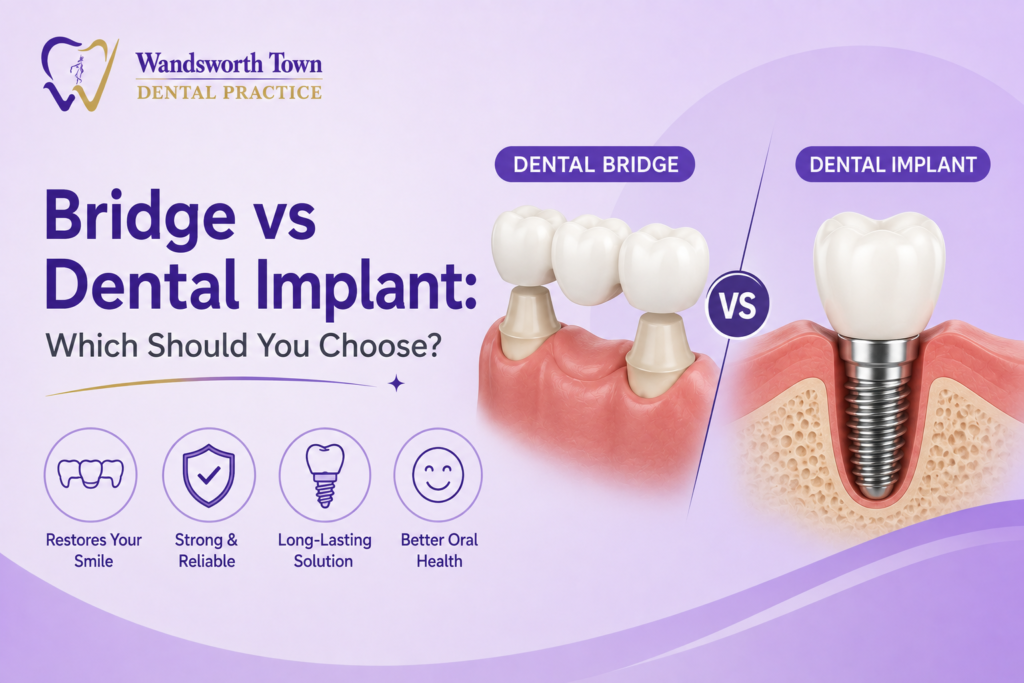
Bridge vs Dental Implant: Which Should You Choose?
Losing a tooth can affect more than your smile. It can make chewing difficult, affect the way you speak, and sometimes cause nearby teeth to move into the empty space. Fortunately, there are several ways to replace a missing tooth, with dental bridges and dental implants being two popular options.
But which one is right for you?
A dental bridge can replace a missing tooth by using the teeth next to the gap for support. A dental implant replaces the missing tooth root and supports a crown that looks and functions like a natural tooth.
The best choice depends on your oral health, bone condition, budget, treatment goals, and long-term plans. This guide explains the key differences between dental bridges and dental implants to help you make an informed decision.
What Is a Dental Bridge?
A dental bridge is a fixed dental restoration used to replace one or more missing teeth. It usually consists of an artificial tooth, called a pontic, supported by crowns attached to neighbouring teeth.
Your dentist prepares the supporting teeth and takes impressions or digital scans of your mouth. The dental laboratory then creates a custom bridge that matches the colour, shape, and size of your natural teeth.
Once ready, your dentist securely fits the bridge into place.
Benefits of Dental Bridges
Dental bridges can offer several advantages:
- They provide a relatively quick way to replace a missing tooth.
- They can improve your smile and appearance.
- They restore some chewing function.
- They are fixed in place rather than removable.
- Treatment may require less time than implant treatment.
- They may be suitable for patients who do not have enough jawbone for an implant.
However, bridges require support from neighbouring teeth, which may need to be prepared.
What Is a Dental Implant?
A dental implant is a small titanium or other suitable implant placed into the jawbone to replace the root of a missing tooth.
After the implant has healed and integrated with the bone, your dentist attaches an abutment and a custom-made dental crown. The finished restoration is designed to look and feel as natural as possible.
Because the implant replaces the tooth root, it does not normally rely on neighbouring teeth for support.
Benefits of Dental Implants
Dental implants can provide important long-term benefits:
- They look and feel similar to natural teeth.
- They provide strong support for chewing.
- They do not require neighbouring healthy teeth for support.
- They can help maintain the jawbone around the missing tooth.
- With proper care, they can provide a long-lasting tooth replacement.
- They can improve confidence when eating and smiling.
However, implant treatment usually takes longer than a traditional dental bridge because the implant needs time to heal and integrate with the jawbone.
Dental Bridge vs Dental Implant: Key Differences
Although both treatments can replace missing teeth, they work in different ways.
Feature | Dental Bridge | Dental Implant |
Supports replacement tooth | Uses neighbouring teeth | Uses an implant in the jawbone |
Treatment time | Usually shorter | Usually longer |
Surgery | Usually no implant surgery | Requires implant placement |
Effect on neighbouring teeth | Supporting teeth may need preparation | Usually does not involve neighbouring teeth |
Jawbone stimulation | Does not replace the tooth root | Helps provide root-like stimulation |
Initial cost | Often lower | Usually higher |
Long-term maintenance | Requires good cleaning around the bridge | Requires careful oral hygiene |
Suitability | Depends on supporting teeth | Depends on bone and overall oral health |
Which Is Better: A Bridge or Dental Implant?
There is no single answer because every patient’s situation is different.
A dental bridge may be suitable if you want to replace a missing tooth without implant surgery or if the neighbouring teeth already require crowns or significant restoration.
A dental implant may be a better option if you have good general and oral health, sufficient jawbone, and want a replacement that does not depend on neighbouring teeth.
Your dentist can examine your teeth, gums, bite, and jawbone before recommending the most appropriate option.
Dental Implant vs Bridge: Which Lasts Longer?
Both dental bridges and implants can provide long-term tooth replacement when properly planned and maintained.
However, their expected lifespan can vary depending on factors such as:
- Oral hygiene
- Gum health
- Bite and chewing forces
- Smoking
- Diet and lifestyle
- Regular dental check-ups
- The quality and condition of the supporting teeth
- Proper maintenance
Dental implants can be a durable long-term solution, while bridges may eventually need repair or replacement.
This does not mean that an implant is automatically the best choice for everyone. Your dentist needs to consider your individual circumstances before recommending treatment.
Is a Dental Implant More Expensive Than a Bridge?
In many cases, dental implants have a higher initial cost than dental bridges. This is because implant treatment can involve several stages, including implant placement, healing, the abutment, and the final crown.
A dental bridge may have a lower upfront cost and can often be completed more quickly.
However, it is important to consider long-term value rather than price alone. A treatment that suits your oral health and can be maintained effectively may provide better value over time.
Your dentist can explain the total treatment cost and available options during your consultation.
Can Everyone Have a Dental Implant?
Not everyone is immediately suitable for dental implant treatment.
Your dentist may assess:
- The amount and quality of your jawbone
- Your gum health
- The condition of your remaining teeth
- Your bite
- Your general health and medical history
- Your oral hygiene
- Lifestyle factors such as smoking
If you have experienced bone loss, you may still be able to have an implant after additional treatment, such as bone grafting, depending on your individual situation.
A detailed assessment is therefore important before deciding on treatment.
What About a Bridge If My Neighbouring Teeth Are Healthy?
If the teeth next to the gap are healthy, your dentist will consider whether preparing them for a traditional bridge is appropriate.
A dental implant can be attractive in this situation because it can replace the missing tooth without using healthy neighbouring teeth as supports.
However, an implant involves surgery and a longer treatment process, so your dentist will discuss the benefits and potential risks before making a recommendation.
How Do You Care for a Dental Bridge or Implant?
Good oral hygiene is essential for both options.
Brush your teeth twice a day with fluoride toothpaste and clean carefully around the restoration. Your dentist or hygienist may also recommend interdental brushes, floss, or other cleaning aids.
Regular dental check-ups can help your dental team monitor your gums, teeth, bridge, or implant.
If you grind your teeth or have a strong bite, your dentist may also recommend additional protection, such as a night guard.
Bridge vs Dental Implant: Which Should You Choose?
The right treatment depends on your individual needs.
A dental bridge may be a practical choice when you want a faster tooth replacement or when the neighbouring teeth can provide suitable support.
A dental implant may be a suitable option when you want to replace both the missing tooth and its root without relying on neighbouring teeth.
Rather than choosing based only on cost or treatment time, consider your oral health, long-term goals, appearance, comfort, maintenance, and overall suitability.
Get Personalised Advice at Wandsworth Town Dental Practice
If you have a missing tooth and are unsure whether a dental bridge or dental implant is right for you, professional advice can help you make a confident decision.
At Wandsworth Town Dental Practice, our dental team can assess your oral health, discuss your treatment goals, and explain the available tooth replacement options.
Every smile is different, so we focus on finding a solution that suits your individual needs.
Book a dental consultation today to discuss your tooth replacement options and find out whether a bridge or dental implant could be right for you.
Follow up Instagram and Facebook for more information.
Frequently Asked Questions
Is a dental implant better than a bridge?
Neither option is automatically better for everyone. Dental implants and bridges have different benefits, and your dentist can recommend the most suitable option based on your oral health and treatment goals.
Which is cheaper, a bridge or an implant?
A dental bridge often has a lower initial cost than an implant. However, the overall cost depends on the number of teeth being replaced, your oral health, and the treatment required.
Does a dental implant look natural?
Yes. A dental implant topped with a custom-made crown can be designed to closely match the colour, shape, and appearance of your natural teeth.
How long does a dental bridge last?
The lifespan of a bridge varies depending on oral hygiene, supporting teeth, bite forces, and maintenance. Regular dental examinations can help identify problems early.
Can I get an implant after having a bridge?
In some cases, an implant may be possible after a bridge has been removed. Your dentist will need to assess the condition of your gums, jawbone, and surrounding teeth before recommending treatment.
How do I know which option is right for me?
The best way to decide is to have a dental assessment. Your dentist can examine the missing tooth area and explain the advantages, limitations, costs, and expected treatment time of each option.